 Image 1 of 1
The Jupiter-8 is the sound of a record sounding finished. Wide, glassy, slightly hollow, and large enough that you stop reaching for something to put behind it.
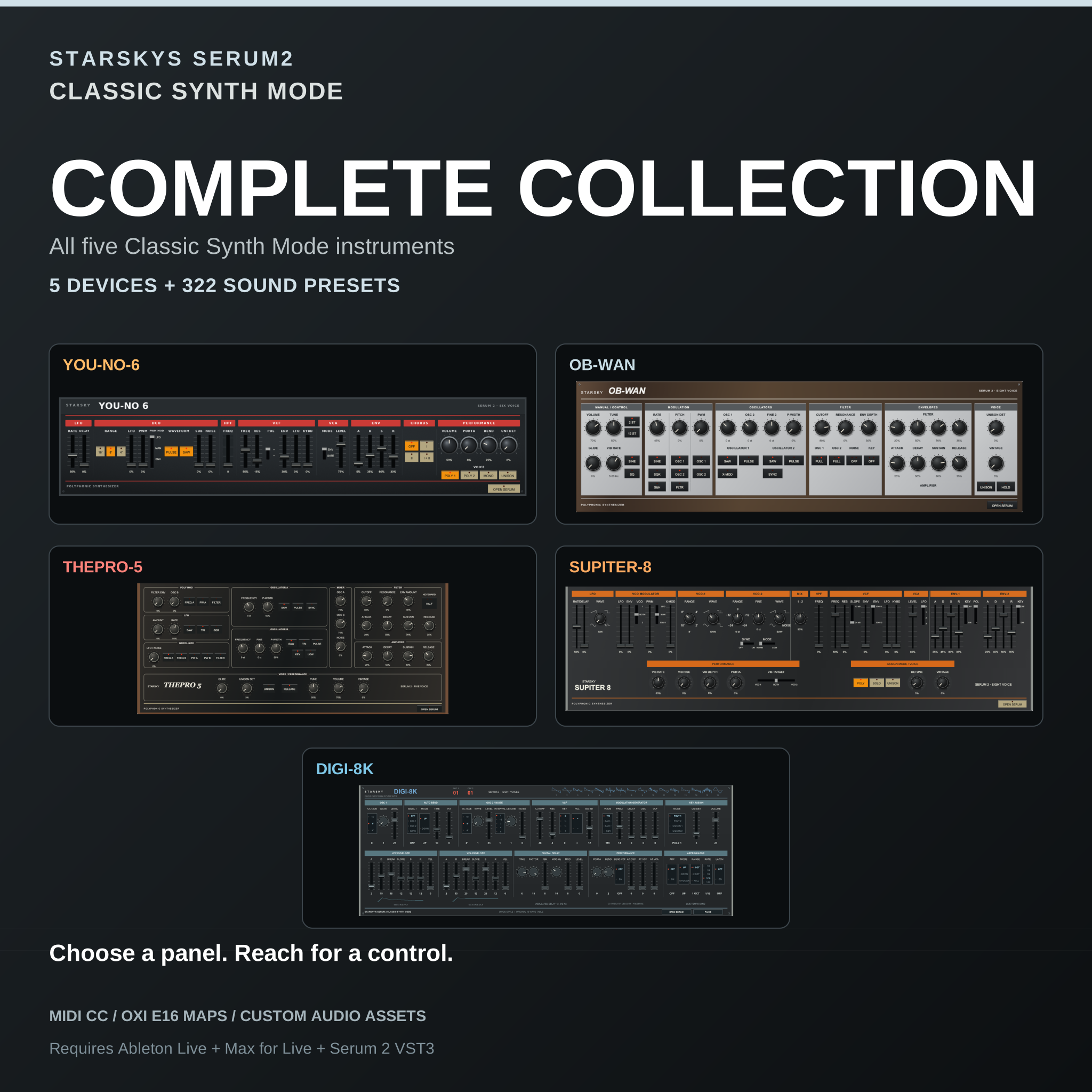
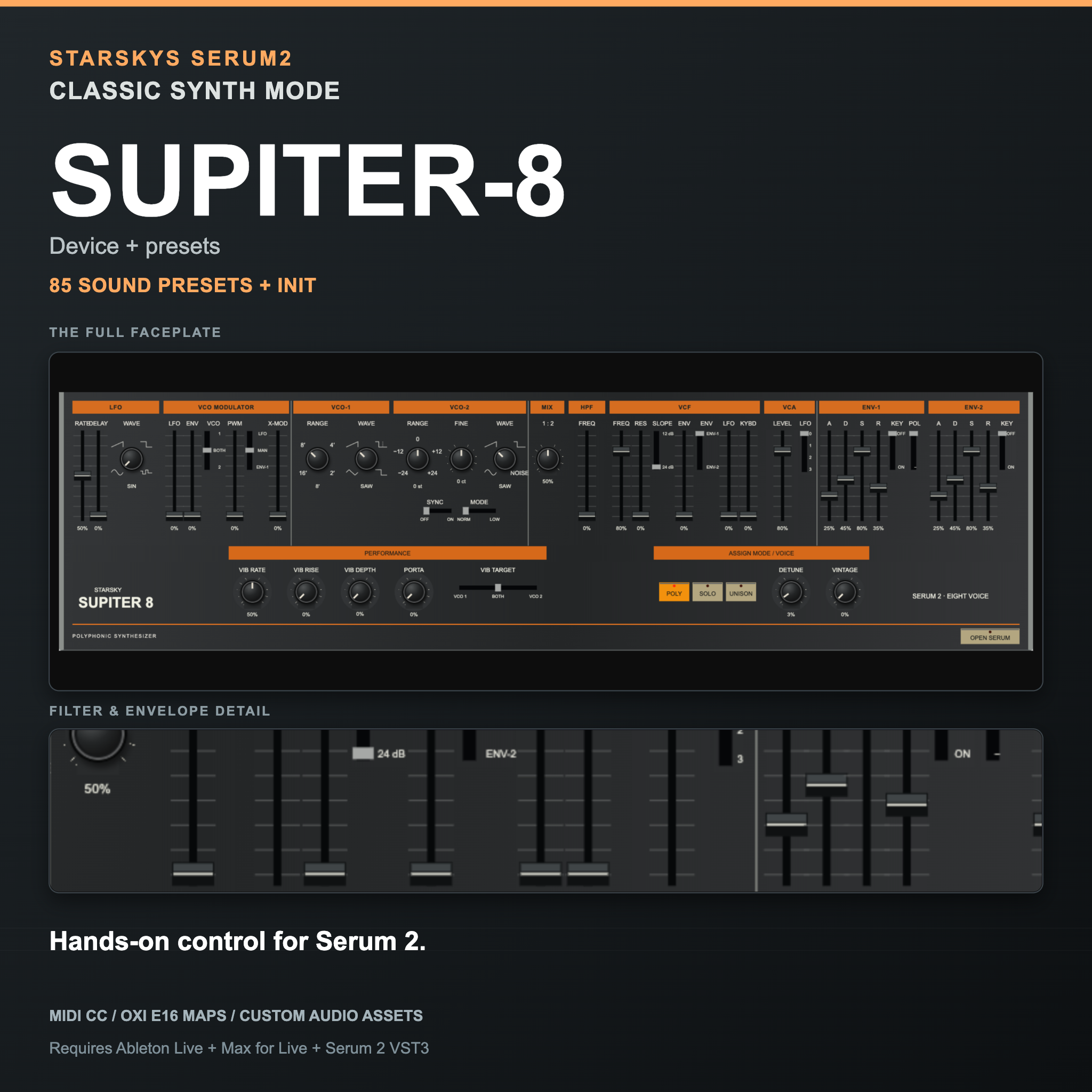
SUPITER-8 is the widest-sounding panel of the five, and the one to load when a track needs one part to do the heavy lifting. Every knob and switch laid out the way the original had it, inside Ableton Live, with Serum 2 underneath.
WHAT IT SOUNDS LIKE
Two oscillators with the Jupiter's own waveform set, cross modulation, the separate high-pass filter, and a low-pass voiced for those glassy, slightly hollow string and brass sounds. The performance section is the part people forget: modwheel-driven PWM, vibrato with a real rise time, and LFO routings that let one held chord move for eight bars without you touching anything else.
WHAT'S IN IT
The SUPITER-8 Max for Live device, with a compact panel for the Live device chain and a full-size faceplate that opens in its own window.
85 sounds as Ableton .adv files, plus an Init patch — heavy on the material the Jupiter is famous for. "Jupiter Strg", "Jupiter PWM", "AngelStrings", "Classic Poly" and "BigPolYGlide", a long run of modwheel and LFO performance patches, and the eighties basses and sequenced sounds.
85 native Serum 2 presets, so the sounds come with you into any DAW, with no Ableton and no Max for Live.
The custom wavetable and noise sample, the full MIDI CC allocation list, an optional OXI E16 scene and instrument map, an illustrated installation PDF and the licence.
HANDS-ON CONTROL
Every control answers to ordinary MIDI CC with no MIDI Learn to set up first — plug a controller in and the panel moves. Standard allocations where they make sense: CC74 cutoff, CC71 resonance, CC7 volume, CC5 glide. Notes, pitch bend and sustain pass straight through.
The Jupiter-8 is the sound of a record sounding finished. Wide, glassy, slightly hollow, and large enough that you stop reaching for something to put behind it.
SUPITER-8 is the widest-sounding panel of the five, and the one to load when a track needs one part to do the heavy lifting. Every knob and switch laid out the way the original had it, inside Ableton Live, with Serum 2 underneath.
WHAT IT SOUNDS LIKE
Two oscillators with the Jupiter's own waveform set, cross modulation, the separate high-pass filter, and a low-pass voiced for those glassy, slightly hollow string and brass sounds. The performance section is the part people forget: modwheel-driven PWM, vibrato with a real rise time, and LFO routings that let one held chord move for eight bars without you touching anything else.
WHAT'S IN IT
The SUPITER-8 Max for Live device, with a compact panel for the Live device chain and a full-size faceplate that opens in its own window.
85 sounds as Ableton .adv files, plus an Init patch — heavy on the material the Jupiter is famous for. "Jupiter Strg", "Jupiter PWM", "AngelStrings", "Classic Poly" and "BigPolYGlide", a long run of modwheel and LFO performance patches, and the eighties basses and sequenced sounds.
85 native Serum 2 presets, so the sounds come with you into any DAW, with no Ableton and no Max for Live.
The custom wavetable and noise sample, the full MIDI CC allocation list, an optional OXI E16 scene and instrument map, an illustrated installation PDF and the licence.
HANDS-ON CONTROL
Every control answers to ordinary MIDI CC with no MIDI Learn to set up first — plug a controller in and the panel moves. Standard allocations where they make sense: CC74 cutoff, CC71 resonance, CC7 volume, CC5 glide. Notes, pitch bend and sustain pass straight through.